

Yes. DataForSEO is cheaper than the Ahrefs API for nearly every workload a freelancer or agency runs. You pay per call from a small prepaid balance, while Ahrefs only opens API access on its Enterprise plan, which runs about $1,500 a month on annual billing. The two are not interchangeable, though. DataForSEO sells raw data by the request, including live Google results. Ahrefs sells metered access to the proprietary index behind its own app.
TL;DR:
- DataForSEO has no subscription. You prepay a balance and each API call draws it down, so a light month costs only a few dollars.
- Ahrefs restricts its API to the Enterprise tier. That puts the entry price in four figures a month before you make a single request.
- Pay-per-call stops being cheap when you check rankings daily at volume. At about 1.6 cents per fresh check, 500 keywords a day costs roughly $240 a month, against about $49 for an entry-level rank-tracking subscription.
- Ahrefs is the rational buy when your product depends on its backlink metrics, such as Domain Rating, at a scale where flat pricing wins.
- Free tools such as Google Search Console and Ahrefs Webmaster Tools cover your own verified sites. They do not cover competitors or bulk SERP data.
Table of Contents
- Is DataForSEO Cheaper Than the Ahrefs API? The Entry Price Gap
- What You Are Actually Buying: Live SERPs vs. a Proprietary Index
- Where the Cheap Option Gets Expensive: Daily Checks at Volume
- When the Ahrefs API Is the Rational Choice
- DataForSEO vs. Semrush: Which Is Better for SEO Work?
- Alternatives to DataForSEO, and the Free Options for Ahrefs
- How to Estimate Your Own Bill Before You Commit
- Own Your Rank Tracker and Pay DataForSEO Only for the Checks You Run
- Frequently Asked Questions
- Sources
Is DataForSEO Cheaper Than the Ahrefs API? The Entry Price Gap

The gap is widest at the bottom of the market. DataForSEO's pricing is pay-as-you-go: you fund an account balance (the minimum payment has been $50), and every request draws down that balance at a published per-call rate. Nothing renews, nothing expires monthly, and a quiet month costs close to nothing.
The Ahrefs API works on a different model. API v3 access comes with the Enterprise plan, the top tier on Ahrefs' pricing page, and usage is metered in API units on top of that. If you already pay for a Lite, Standard or Advanced Ahrefs plan, you do not have API access. That point settles the recurring Reddit question of whether you "need DataForSEO if you already have Ahrefs." If you want programmatic data and you are not on Enterprise, you need something else.
| DataForSEO | Ahrefs API | |
|---|---|---|
| Billing model | Prepaid balance, pay per request | Enterprise subscription plus metered API units |
| Minimum to start | Small top-up (has been $50) | Enterprise plan, roughly $1,500/month billed annually |
| Live Google SERPs | Yes, core product | Not its purpose |
| Backlink data | Own index, separate Backlinks API | Ahrefs' own index and metrics (DR, UR) |
| Keyword volumes | Yes, including Google Ads-sourced data | Yes, Ahrefs' own estimates |
| Cost of an idle month | Near zero | Full plan price |
Below Enterprise, Ahrefs sells no API access at all. Any plan under its top tier gives you the app and nothing you can call from code.
What You Are Actually Buying: Live SERPs vs. a Proprietary Index

The key difference between DataForSEO and Ahrefs is what sits behind the endpoint. DataForSEO is a data wholesaler. Its SERP API fetches Google results when you ask, its Keywords Data API returns search volumes, and its Backlinks API queries the company's own link index. You get raw, structured JSON and build whatever you want on top of it.
Ahrefs is a product company that also exposes its data. The API returns the same numbers you see in the Ahrefs app: Domain Rating, URL Rating, referring domains, organic keyword estimates. If a client deck or internal dashboard is built around "DR 54," only Ahrefs can supply that exact metric. DataForSEO offers its own authority scores, and those are not the same scale.
For rank tracking specifically, the distinction is decisive. Tracking positions means asking Google what it shows today, for a given keyword, country and device. DataForSEO's SERP API is built for exactly that. Ahrefs' index is built to answer different questions: who links to whom, and roughly what a site ranks for in aggregate. If rank tracking is your workload, DataForSEO is the better fit before price even enters the comparison. Our breakdown of the Ahrefs rank tracker's costs covers the in-app option separately.
Where the Cheap Option Gets Expensive: Daily Checks at Volume
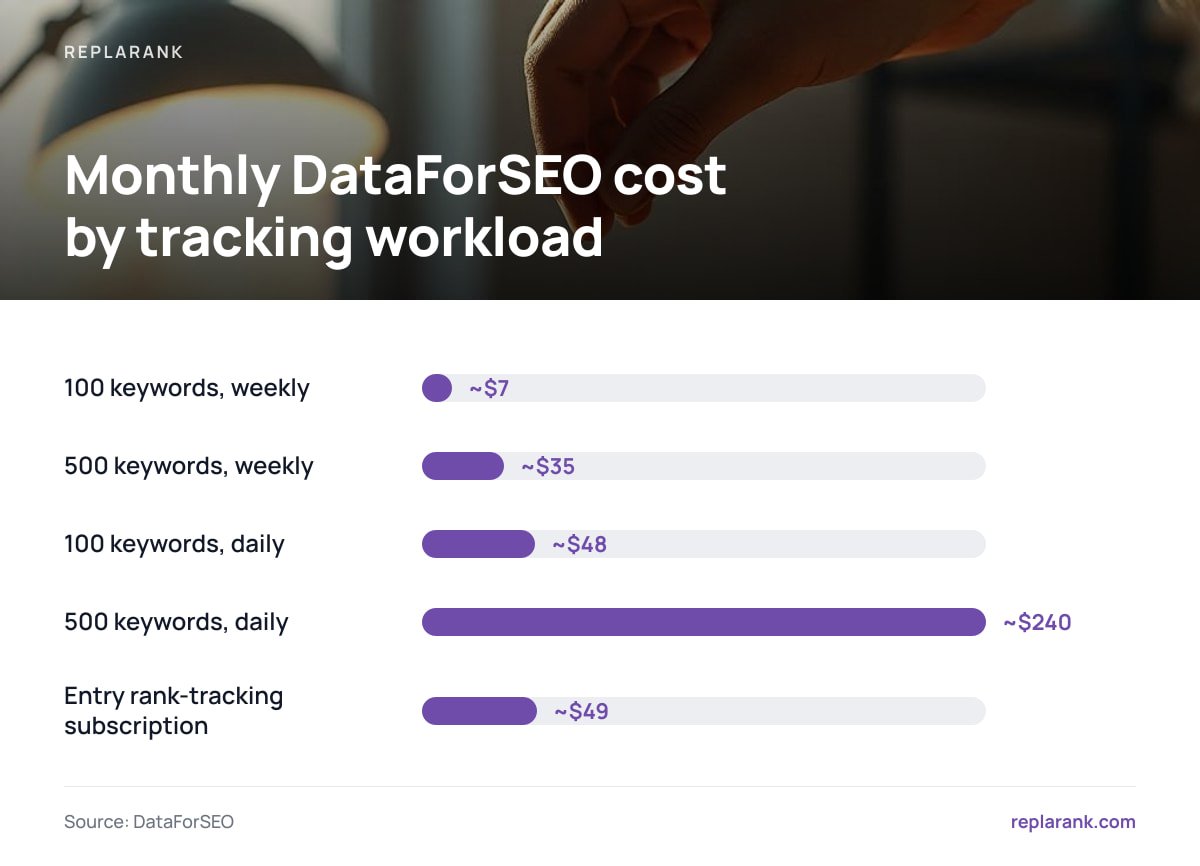
Most comparisons stop at "pay-per-call is cheaper." That holds until your check count gets large. A fresh rank check, meaning one keyword pulled live with the data a tracker needs, costs roughly 1.6 cents at DataForSEO rates. Multiply that by keywords, then by checks per month, and the result can overtake a flat subscription.
| Workload | Checks per month | Approx. DataForSEO cost | Entry-level rank-tracking subscription |
|---|---|---|---|
| 100 keywords, weekly | ~430 | ~$7 | ~$49 |
| 500 keywords, weekly | ~2,170 | ~$35 | ~$49 |
| 100 keywords, daily | ~3,000 | ~$48 | ~$49 |
| 500 keywords, daily | ~15,000 | ~$240 | ~$49 |
500 keywords checked daily is about $240 a month at cost. An entry-level rank-tracking subscription covering the same keywords costs around $49.
The pattern is simple. Pay-per-call wins on weekly cadence and on small keyword sets. A subscription wins on daily checking at volume, because subscription vendors buy data in bulk and spread the cost across thousands of customers. If you track 500 keywords daily for a single site, a subscription is cheaper, and paying per call at that volume is the wrong choice. The full arithmetic is in why pay monthly for rank tracking.
The pay-per-call math improves again in a few cases:
- You run many sites or seats. Subscriptions price by projects, keywords and users. Raw API cost does not change when you add a colleague.
- You need weekly data. Most rankings do not move meaningfully day to day, so daily checks often buy you noise.
- Your volume is uneven. A launch month and a dead month cost very different amounts, which suits a prepaid balance.
When the Ahrefs API Is the Rational Choice
Ahrefs is the better buy when three conditions hold together. Your product or reporting depends on Ahrefs-specific metrics. You query backlink data heavily every month. And your organization already pays for Enterprise seats for other reasons. In that situation the API's marginal cost is only the units you consume, and switching providers would mean rebuilding reports around different metrics.
It is also defensible when link data quality is the whole job. Agencies doing link audits or spotting spammy backlinks at scale sometimes prefer Ahrefs' index for coverage and freshness on the domains they care about.
For everyone else, especially anyone building internal tools, rank trackers or AI-agent workflows, Enterprise pricing is a large fixed cost for data you could buy per request. We would pick DataForSEO for those use cases without hesitation.
DataForSEO vs. Semrush: Which Is Better for SEO Work?
Semrush is a poor fit for this comparison on cost, and an even worse one on access. Its API requires the Business plan, roughly $500 a month, and API units are bought separately on top, as described in the Semrush API documentation. Like Ahrefs, it sells programmatic access to its own database, not live SERP fetching.
As an app, Semrush is better than DataForSEO, because DataForSEO is not an app. You get no interface, no reports and no dashboards. If you want a complete SEO suite you log into, Semrush wins.
As a data source you build on, DataForSEO is better. It has a lower entry cost, per-call pricing, live SERPs in many locations, and no plan tier gating access. Choose based on whether you are buying a tool or buying ingredients.
Alternatives to DataForSEO, and the Free Options for Ahrefs
Paid DataForSEO alternatives
- SerpApi. Strong for live SERP scraping with clean JSON, and it covers several search engines. Its published plans are monthly subscriptions sized by search count. The entry paid tier works out to roughly 1.5 cents per search, so it is competitive only if you use the allowance every month.
- Semrush API. Database access gated behind the Business plan. It makes sense if you already pay for Semrush.
- Ahrefs API. The best choice for Ahrefs-native backlink metrics, with an Enterprise-only entry cost.
Free alternatives to Ahrefs
Free options exist, with one hard limit: they only show data for sites you have verified you own.
- Google Search Console. It provides real clicks, impressions and average position from Google itself. It is the most accurate free ranking data available. Google retains only 16 months of performance history.
- Ahrefs Webmaster Tools. Free site audits and backlink data for verified sites, drawn from Ahrefs' own index.
Neither tool shows competitor data, and neither offers bulk SERP checks for arbitrary keywords. For your own properties, they cover more than most people expect.
How to Estimate Your Own Bill Before You Commit
Do not compare plans by keyword count. Compare them by checks per month: keywords × countries × devices × checks per month. Tracking 200 keywords on desktop and mobile in two countries, weekly, comes to about 3,460 checks, or roughly $55 a month at 1.6 cents each. Run the same setup daily and the cost is about $384.
Pro Tip: Split your keyword list by cadence before you pick a provider. Check your 30 to 50 revenue keywords daily and everything else weekly. For a 500-keyword list, that mix lands near $60 to $70 a month in API cost instead of $240. It also produces cleaner trend lines, because weekly data on long-tail terms filters out Google's day-to-day noise. A per-client spend cap matters as much as the price per call, because one misconfigured daily job is how pay-per-call bills surprise people.
If you are weighing the infrastructure side of this as well, our comparison of self-hosted vs. cloud SEO tools covers hosting, maintenance and data ownership.
Own Your Rank Tracker and Pay DataForSEO Only for the Checks You Run

ReplaRank is a self-hosted rank tracker you buy once for $399. It runs on your own server and draws on your own DataForSEO account at cost, roughly 1.6 cents per fresh check. You get unlimited sites and users, and isolated brands, each with its own spend limit, so a runaway job cannot drain your balance. Alongside position history it flags 404s, redirects, noindex and canonical problems on desktop, mobile or both. It tracks 35 countries and syncs Search Console daily, keeping history beyond Google's 16 months.
The honest limit: if you check 500 keywords every day, ReplaRank's data cost is about $240 a month, and a $49 subscription is the cheaper choice. It also has no scheduled reports and no white labeling. ReplaRank pays off on weekly checks, smaller keyword sets, many sites, and owning the tool outright.
Frequently Asked Questions
Is DataForSEO cheaper than the Ahrefs API?
For most workloads, yes. DataForSEO charges per request from a small prepaid balance, while Ahrefs only offers API access on its Enterprise plan, roughly $1,500 a month on annual billing. The exception is heavy, Ahrefs-specific backlink querying by teams already paying for Enterprise.
Do I need DataForSEO if I already use Ahrefs?
If you are on any Ahrefs plan below Enterprise, you have no API access, so any programmatic or automated workflow needs another data source. If you only use the Ahrefs app interactively and never build tools, you may not need DataForSEO at all.
Is checking rankings through DataForSEO cheaper than a rank-tracking subscription?
Only at low volume or weekly cadence. At about 1.6 cents per fresh check, 500 keywords checked daily costs around $240 a month, while an entry-level subscription runs about $49. Weekly checking of the same 500 keywords costs about $35.
Is there a free alternative to Ahrefs?
Google Search Console and Ahrefs Webmaster Tools are both free and genuinely useful, but only for sites you have verified you own. Neither provides competitor data or bulk SERP checks for arbitrary keywords.
Which is better for SEO, DataForSEO or Semrush?
Semrush is better if you want a finished app with reports and dashboards. DataForSEO is better if you are building your own tools, because it has per-call pricing, live SERPs and no plan gating. Semrush's API requires the Business plan plus separately purchased units.
Sources
- DataForSEO Pricing | DataForSEO
- Ahrefs API | Ahrefs
- Ahrefs Pricing | Ahrefs
- Semrush API Documentation | Semrush
- SerpApi Pricing | SerpApi
- About Search Console | Google