

The Ahrefs rank tracker is a cloud dashboard bundled inside Ahrefs' paid SEO subscription — you rent access to it monthly, and your position history lives on their servers for as long as you keep paying. The distinction that actually matters isn't feature count; it's whether you want to rent that history indefinitely or pay once and own the checking engine. For small keyword sets checked weekly, owning costs less within a year. For large sets checked daily, a subscription usually wins.
TL;DR:
- The Ahrefs rank tracker is a feature inside a larger paid suite, not a standalone product — you can't buy just the tracking.
- Cost depends almost entirely on check frequency and keyword volume, not on which tool you pick.
- A fresh SERP check through a pass-through provider like DataForSEO runs roughly 1.6 cents; checking 500 keywords daily adds up to around $240 a month.
- Subscriptions win at high daily volume; self-hosted tools win on weekly checks, small sets, and unlimited sites or users.
- Google Search Console itself only retains about 16 months of query data, so any tracker worth using should store history beyond that window.
Table of Contents
- What the Ahrefs Rank Tracker Actually Monitors
- The Subscription Model: What You're Actually Renting
- The Real Cost Driver Is Checking Frequency, Not the Tool
- Self-Hosted vs. SaaS: Where Each One Actually Wins
- Page Health Checks: The Diagnostic Most Trackers Skip
- Search Console Data and the 16-Month Wall
- When the Subscription Still Wins
- Own the Checking Engine Instead of Renting the Dashboard
- Frequently Asked Questions
- Sources
What the Ahrefs Rank Tracker Actually Monitors

Ahrefs' rank tracking lives inside its broader SEO platform, alongside Site Explorer and Keywords Explorer, rather than as a product you can buy on its own. It checks keyword positions on Google by country and device, flags SERP feature changes, and lets you benchmark against competitor domains. The update frequency and the number of keywords you can track both scale with your subscription tier — more keywords or faster refresh rates mean a higher plan, not an add-on fee.
That bundling is the first thing worth understanding before you compare price. You're not paying for rank tracking in isolation; you're paying for a suite where rank tracking is one module among several. If you only need position history and page diagnostics, you're still funding backlink indexes and content tools you may never open.
The Subscription Model: What You're Actually Renting

Every SaaS rank tracker, Ahrefs included, works the same way financially: you pay monthly or annually, your historical data sits on their infrastructure, and the moment you stop paying, you lose access to that history. There's no local export that preserves the full dashboard — just whatever CSV you remembered to pull before canceling. The related breakdown on monthly rank tracking costs walks through this math in more detail, but the short version is that renting is cheap at first and expensive forever, because the meter never stops.
This isn't a flaw unique to Ahrefs — it's how the entire SaaS category is built. The question worth asking isn't "is this subscription fairly priced," it's "will I still want this data in three years, and do I want to keep paying to see it."
The Real Cost Driver Is Checking Frequency, Not the Tool

Almost every rank tracking comparison skips the one variable that actually determines your bill: how often you check, multiplied by how many keywords you're checking. A SERP data pass-through provider like DataForSEO prices fresh checks per keyword per location, and that per-check cost is roughly 1.6 cents regardless of which front-end tool queries it.
Run that math at volume and the picture flips. Checking 500 keywords once a day for a month means roughly 15,000 checks, which lands around $240 — more than double what a basic SaaS plan like Wincher's entry tier (around $49 a month) charges for the same workload. At that frequency, a subscription that amortizes the data cost across thousands of customers is simply cheaper than paying for raw checks yourself.
500 keywords checked daily costs roughly $240 a month in raw data fees alone — nearly five times what a $49 subscription plan charges for the same volume.
Flip the frequency to weekly instead of daily, or drop the keyword count into the low hundreds, and the math reverses just as sharply. Fewer checks means the per-check cost barely registers, and a one-time tool purchase starts looking far cheaper than a recurring bill you'll still be paying in year three. The keyword rank tracker cost breakdown has the full table if you want to run your own numbers before committing either way.
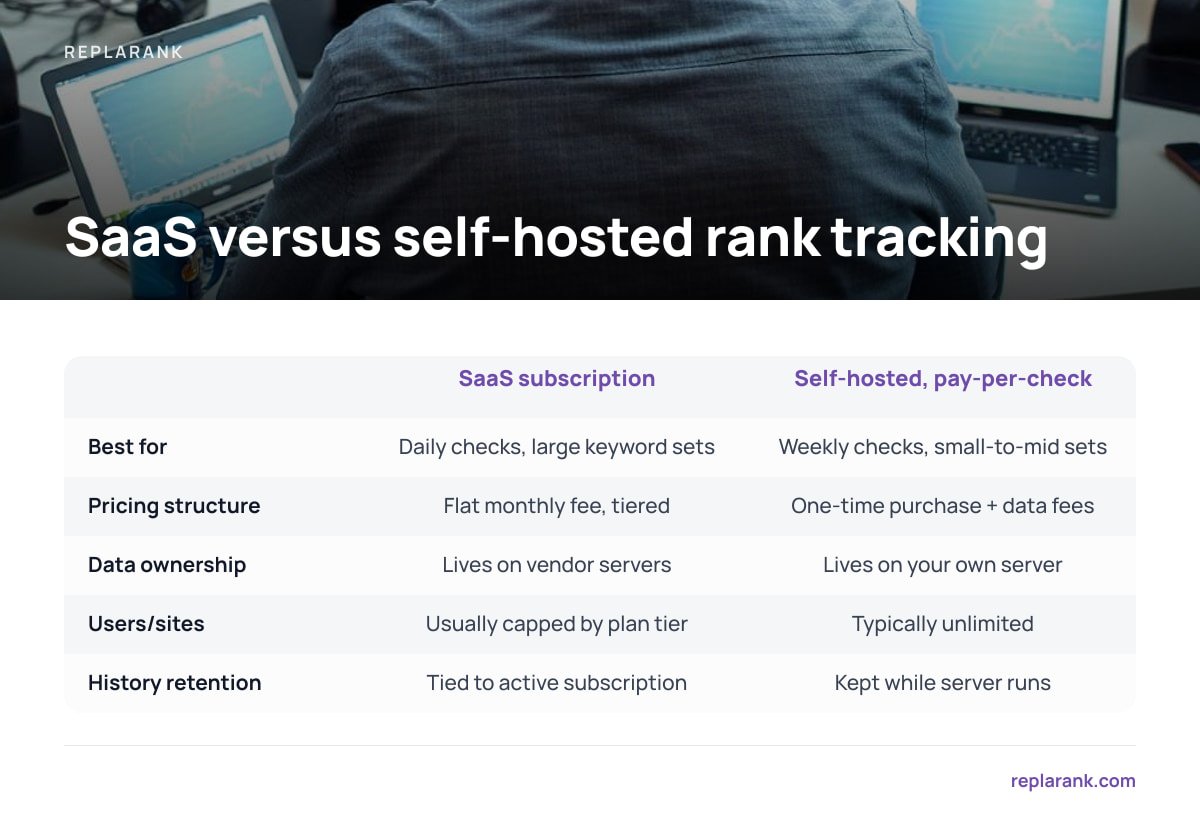
Self-Hosted vs. SaaS: Where Each One Actually Wins
| Factor | SaaS (Ahrefs-style subscription) | Self-hosted, pay-per-check |
|---|---|---|
| Best for | Daily checks, large keyword sets | Weekly checks, small-to-mid sets |
| Pricing structure | Flat monthly fee, tiered by volume | One-time purchase + at-cost data fees |
| Data ownership | Lives on vendor servers | Lives on your own server |
| Users/sites | Usually capped by plan tier | Typically unlimited |
| History retention | Tied to your subscription staying active | Kept as long as you keep the server running |
| Extra modules bundled in | Backlinks, content tools, keyword research | Varies by product |
Neither column is universally right. If you're tracking 2,000 keywords daily for a dozen enterprise clients, the subscription's flat fee is doing you a favor by absorbing data costs you'd otherwise pay directly. If you're an independent consultant tracking 150 keywords across three client sites once a week, you're paying for infrastructure and refresh capacity you'll never use.
Pro Tip: Before comparing sticker prices, count how many of your tracked keywords actually moved in the last 30 days. Most practitioners discover that fewer than a third of their list shifts position week to week — which means daily checking on the rest is pure waste, regardless of which tool is doing the checking.
Page Health Checks: The Diagnostic Most Trackers Skip
Position history tells you where a page ranks. It doesn't tell you whether that page is about to disappear from the index. A page can hold rank 4 for weeks while quietly carrying a 404 on a linked resource, a redirect chain that's lost PageRank at each hop, or a stray noindex directive that Google hasn't recrawled yet. Google's own Search Central documentation on the robots meta tag covers exactly how a misapplied noindex or canonical tag can pull a page out of the index without any visible ranking drop until the next crawl catches it.
Rank trackers that only report position numbers will show you a stable graph right up until the page vanishes. A tracker that checks page health alongside rank — 404s, redirect chains, noindex tags, canonical mismatches — catches the problem while there's still time to fix it, not after the traffic is already gone.
Search Console Data and the 16-Month Wall
Google Search Console is the only source of real click and impression data tied to your actual rankings, which makes it worth connecting to whatever rank tracker you use. The catch is retention: Google's Search Console Help documentation confirms the interface only shows roughly the last 16 months of query data by default. Anything older simply isn't there unless you've been exporting it yourself.
Google Search Console retains about 16 months of query data — anything older than that is gone unless you've been storing it elsewhere.
That's a meaningful gap for anyone running year-over-year reporting. A tracker that syncs Search Console data daily and keeps its own archive by query and date solves this without you having to remember to export CSVs on a schedule. It's one of the few places where a self-hosted setup has a structural advantage over relying on Google's interface alone.
When the Subscription Still Wins
None of this is an argument that self-hosting is always cheaper or always better. If you're checking thousands of keywords daily, managing dozens of client accounts, or need a team of non-technical users logging into a shared dashboard without touching a server, a subscription's flat monthly fee and managed infrastructure earn their keep. The comparison of self-hosted versus SaaS rank trackers breaks down the volume threshold in more detail, but the rule of thumb holds: high frequency and high volume favor renting; low frequency and ownership preference favor buying once. If you're tracking rankings across multiple markets, the guide to tracking rankings by country is worth reading before you pick either model, since country-level pricing and location granularity vary a lot between tools.
Own the Checking Engine Instead of Renting the Dashboard
If your checking frequency is weekly rather than daily, and your keyword count is in the hundreds rather than the thousands, ReplaRank is built for exactly that math. It's a self-hosted rank tracker you buy once for $399, run on your own server, and pay DataForSEO directly at cost for each check — no markup, no monthly meter running whether you check or not. It tracks mobile rankings across 35 countries, flags 404s, redirects, noindex tags, and canonical issues on desktop or mobile, and syncs Search Console data daily so you keep history past Google's 16-month window, broken out by query and date.
The honest caveat: if you're checking 500+ keywords every single day, the per-check data cost will run higher than a comparable SaaS plan, so do that math before you buy. ReplaRank doesn't include scheduled email reports or white-labeling — check the spec sheet against what your workflow actually needs before switching.
Frequently Asked Questions
Is the Ahrefs rank tracker sold as a standalone product?
No. Rank tracking is a feature inside Ahrefs' broader paid SEO subscription, which also includes backlink analysis, keyword research, and content tools. You can't purchase rank tracking alone at a lower tier.
How much does daily rank checking actually cost?
At a rough rate of 1.6 cents per fresh SERP check, tracking 500 keywords once a day for a month comes to around $240 in raw data fees, which is more than most entry-level subscription plans charge for the same workload.
When does a self-hosted tracker beat a subscription on price?
Self-hosted tools pull ahead when you're checking a smaller keyword set on a weekly rather than daily basis, since the per-check data cost stays low and you avoid paying a recurring fee for refresh capacity you don't use.
Does Google Search Console show all my historical ranking data?
No. Search Console's interface retains roughly the last 16 months of query data by default, so anything older is gone unless you've exported or archived it elsewhere.
What should a rank tracker check besides keyword position?
It should also flag page-level problems like 404 errors, redirect chains, noindex tags, and canonical mismatches, since a page can lose its ranking entirely without any visible change in the position graph until the next crawl.
Sources
- Robots meta tag, data-nosnippet, and X-Robots-Tag specifications | Google Search Central
- DataForSEO SERP API | DataForSEO
- Wincher Pricing | Wincher