

One-time purchase SEO tools versus monthly subscriptions comes down to how often you check rankings, not the sticker price. A $399 self-hosted license beats a $49-a-month plan on weekly checks, many sites, or many users. Past roughly 100 keywords checked daily, the subscription is cheaper, because with a self-hosted tool you pay the data provider for every check.
TL;DR:
- A one-time license removes the recurring tool fee, but you still pay per check for search data, so total cost depends on keyword count and frequency.
- At roughly 1.6 cents per fresh check, 100 keywords tracked daily costs about $48 a month, which is about the same as a $49 subscription.
- Daily tracking of 500 keywords costs about $240 a month in data fees, so a flat subscription wins there. Weekly tracking of the same list costs about $35.
- Ownership wins on small keyword sets, weekly cadence, unlimited sites and users, and keeping your own history past Search Console's 16-month window.
- Track your top 20 keywords daily and everything else weekly. It cuts a 500-keyword bill from about $240 to about $43.
Table of Contents
- One-Time Purchase SEO Tools vs Monthly Subscriptions: What You're Actually Paying For
- The Break-Even Math, With Check Frequency as the Variable
- Where a Subscription Is Cheaper (and It Isn't Close)
- Where One-Time Purchase Wins: Weekly Checks, Many Sites, Many Users
- The Costs Neither Pricing Page Shows
- Group Buys and Shared Logins: Not a Third Option
- Which One I'd Pick, by Situation
- Run Weekly Rank Tracking Without a Monthly Fee
- Frequently Asked Questions
- Sources
One-Time Purchase SEO Tools vs Monthly Subscriptions: What You're Actually Paying For
A subscription bundles three costs into one fee: the software, the search data, and the hosting. A one-time purchase separates them. You pay once for the software, you pay a data provider per request, and you cover the server yourself.
That separation is the whole story. A flat monthly fee hides the cost of each check, so heavy users get a bargain and light users subsidize them. A one-time license with pay-as-you-go data exposes every check as a line item, so light users pay almost nothing and heavy users pay full price.
If you want the broader landscape before the math, our guide to tracking software types covers what free tools can and cannot do. This article stays on one question: which billing model costs less for your workload.
The Break-Even Math, With Check Frequency as the Variable

Rank data is sold per request. DataForSEO publishes its per-request pricing, and a fresh check through a pay-as-you-go search-data API lands at roughly 1.6 cents. That one number drives everything below. For how per-call billing works in general, see API costs: how you get billed, and when per-call pricing wins.
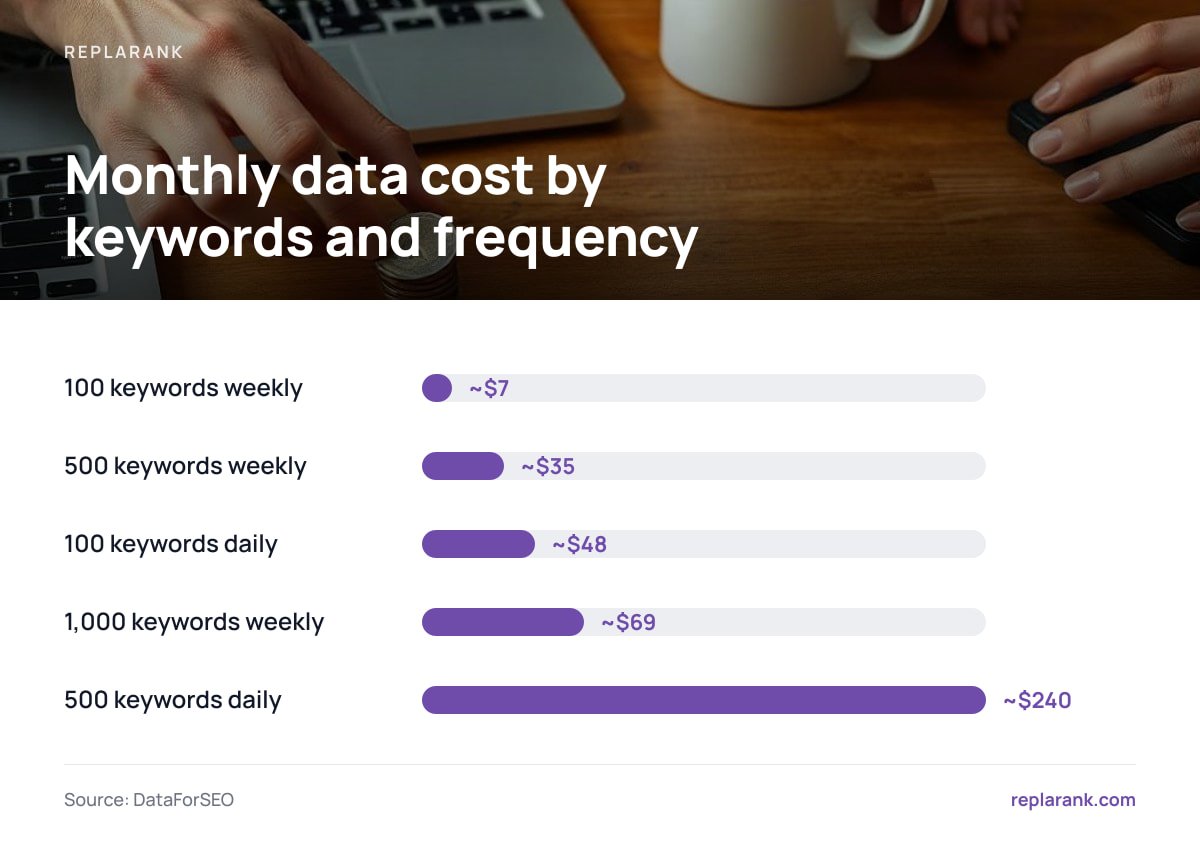
Here is what that rate does against a $49-a-month entry plan, using 30 days for daily checks and 4.33 weeks per month for weekly ones:
| Keywords | Frequency | Checks per month | Data cost at ~1.6¢ | Versus a $49 plan |
|---|---|---|---|---|
| 100 | Weekly | ~433 | ~$7 | ~$42 cheaper |
| 100 | Daily | 3,000 | ~$48 | About even |
| 500 | Weekly | ~2,165 | ~$35 | ~$14 cheaper |
| 500 | Daily | 15,000 | ~$240 | ~$191 more |
| 1,000 | Weekly | ~4,330 | ~$69 | ~$20 more |
The table excludes the $399 license and your server. It also assumes the $49 plan actually covers that many keywords, and entry tiers often cap tracked keywords, so check the cap before you trust the comparison.
About 102 keywords checked daily is the crossover. Below it, per-check pricing costs less than $49 a month. Above it, the flat fee wins.
Where a Subscription Is Cheaper (and It Isn't Close)
If you track several hundred keywords every day, rent the tool. At 500 keywords daily, the data alone runs about $240 a month, nearly five times the entry-plan price. No amount of ownership romance changes that.
Subscriptions also win in these cases:
- Short engagements. A three-month project never reaches break-even on a $399 license. Even at 100 keywords weekly, where you save about $42 a month, payback takes roughly ten months.
- Zero infrastructure appetite. Self-hosting means a server, an install, and someone responsible when it breaks. If that someone is you and you bill $150 an hour, an afternoon of server debugging erases a lot of savings.
- Large daily lists you can't tier. If your client contract demands daily positions on 1,000 keywords, the flat fee absorbs the volume.
Be suspicious of any one-time-purchase pitch that doesn't admit this. "Pay once, track forever" is only cheaper if forever is a modest number of checks.
Where One-Time Purchase Wins: Weekly Checks, Many Sites, Many Users

Rankings rarely move enough in 24 hours to change a decision. For most sites, weekly checks answer every question daily checks would, at a quarter of the cost. Our piece on reading and improving SEO rankings explains why trend lines matter more than single-day positions.
Ownership has a clear edge in three situations:
- Many sites, one bill. Subscriptions commonly meter by project, keyword, or seat. A self-hosted tool doesn't. Ten client sites at 50 keywords each, checked weekly, is the same 500-keyword, roughly $35 data bill as one site.
- Many users. A team of eight pays no per-seat fee, because there is no seat.
- Long horizons. After the license is paid, your monthly cost is data plus server. Against a $49 plan with a small weekly list, payback arrives in about ten months. With 500 keywords weekly, it takes closer to two and a half years, so pick this route for the ownership and flexibility, not a fast payoff.
$399 divided by $42 in monthly savings is 9.5 months. At 500 weekly keywords the monthly saving drops to $14, and payback stretches to about 28 months.
The Costs Neither Pricing Page Shows
The comparison isn't only dollars per check. Two items matter more than most buyers expect.
History you keep versus history you rent
Google's Search Console performance report retains 16 months of data. Anything older is gone unless something stored it. A tool that syncs daily and keeps the rows in a database you control builds a permanent archive by query and date. When you cancel a subscription, whatever history the vendor holds usually leaves with it, so export regularly if you rent.
Position data without page data
A ranking drop is often a page problem, not an algorithm problem: a 404, a redirect chain, a stray noindex. Google's own documentation on blocking indexing says a noindex directive tells it to drop the page from results entirely. A tracker that checks page health alongside position shows you the cause in the same view. If you're already mid-drop, diagnose before fixing.
Pro Tip: Don't track every keyword at the same frequency. Check your 20 highest-value terms daily and the other 480 weekly. That is about 600 daily checks plus roughly 2,080 weekly ones each month, around $43 total, instead of about $240 for all 500 daily. You still catch a real drop on the pages that earn revenue within 24 hours.
Group Buys and Shared Logins: Not a Third Option

Group-buy offers resell shared seats on subscription tools at a steep discount. They look like a middle path between renting and owning, but they carry the downsides of both. Shared logins usually violate the vendor's terms, and access can be cut without notice or refund. You don't own anything, and you can't put a client's data in an account you don't control.
If the budget problem is real, tier your keyword frequency or drop to a smaller plan. Both are safer than a borrowed seat.
Which One I'd Pick, by Situation
Pick the model that matches your workload:
| Your situation | My pick | Why |
|---|---|---|
| Under 100 keywords, weekly checks, one or two sites | One-time purchase | Data costs about $7 a month, and payback takes under a year. |
| Agency with many small client sites, weekly cadence | One-time purchase | No per-site or per-seat fees, and the data bill scales gently. |
| 500+ keywords tracked daily | Subscription | Data fees alone run about $240 a month. |
| Short project, under six months | Subscription | You never reach break-even on a license. |
| You want long-term history and control of your data | One-time purchase | You keep every row, past the 16-month Search Console window. |
My own rule: if you would be comfortable with weekly positions, own the tool. If a client or boss insists on daily numbers across hundreds of keywords, rent.
Run Weekly Rank Tracking Without a Monthly Fee
ReplaRank is a self-hosted rank tracker you buy once for $399. You run it on your own server and pay DataForSEO directly at cost, with no markup on the checks. It covers mobile rank tracking across 35 countries, page-health checks (404s, redirects, noindex, canonical issues) on desktop, mobile, or both, and a daily Search Console sync that keeps history past Google's 16 months, by query and date. Each isolated brand gets its own spend limit, so a runaway keyword list can't surprise you at month end. It also ships a 50-tool MCP server that runs locally over stdio for Claude Desktop, Claude Code, and Cursor.
The caveat is the one this article has been making. A fresh check costs roughly 1.6 cents, so daily tracking at volume costs more than a subscription: 500 keywords daily is about $240 a month against $49. ReplaRank wins on weekly checks, small keyword sets, unlimited sites and users, and owning the thing. If your workload is large and daily, rent instead.
Frequently Asked Questions
Is a one-time purchase SEO tool cheaper than a subscription?
Only for the right workload. With fresh checks costing roughly 1.6 cents each, 100 keywords tracked daily costs about $48 a month in data, which is about the same as a $49 plan. Weekly checks and small keyword sets are cheaper; large daily lists are not.
How many keywords can I track daily before a subscription becomes cheaper?
About 102. Divide $49 by 30 days and by $0.016 per check and you get roughly 102 keywords. Above that number, a flat monthly fee costs less than paying per check.
Do I need technical skills to use a self-hosted rank tracker?
You need to be comfortable running software on a server you control. A one-command install lowers that bar, but you are still responsible for hosting, uptime, and backups. If that sounds like a burden, a subscription removes it for a monthly fee.
What happens to my ranking history if I cancel a subscription?
It depends on the vendor, but history stored in their system typically becomes inaccessible when the account ends, so export it before you cancel. With a self-hosted tool, the data sits in your own database. Search Console itself only keeps 16 months, so storing your own copy matters either way.
Can I reduce per-check costs on a pay-as-you-go tracker?
Yes, by tiering frequency. Track your most valuable 20 keywords daily and the rest weekly, which brings a 500-keyword list to about $43 a month instead of about $240.
Sources
- Search Console Help: Performance report (Search results) | Google
- Block Search Indexing with noindex | Google Search Central
- DataForSEO Pricing | DataForSEO