

An AI SEO agent is a language model that can call tools, such as rank checks, Search Console queries, and page crawls, and then act on what comes back. A chatbot that only writes text about SEO is not an agent in that sense. The distinction that matters is data access. An agent connected to your real ranking and click data can diagnose problems. One without that access is guessing with confidence. The model is the cheap part, and the data calls are where both cost and accuracy live.
TL;DR:
- An AI SEO agent is a model plus tools. Without live ranking or Search Console data, it produces plausible fiction about your site.
- AI agents can do real SEO work: triaging 404s, joining click data to positions, and clustering keywords. They should not decide strategy or publish at scale unreviewed.
- Google's guidance doesn't care whether content is AI-written. Its spam policies do treat mass-produced pages built to manipulate rankings as scaled content abuse.
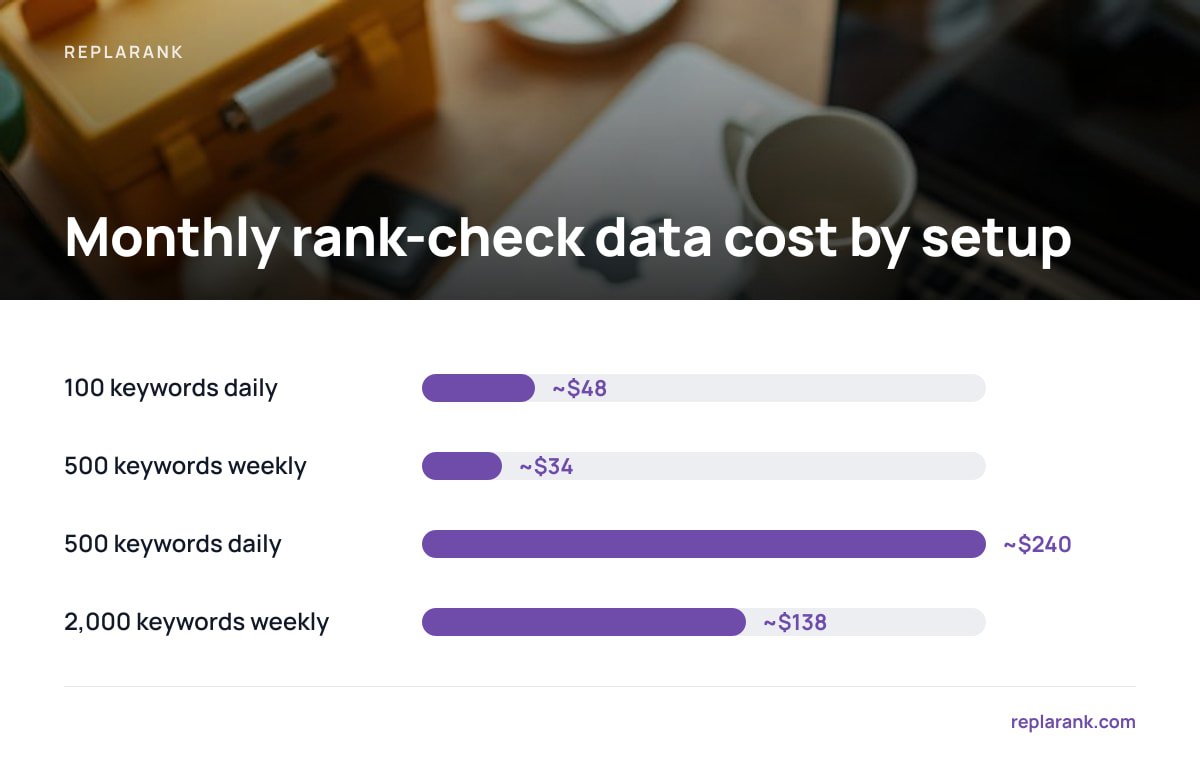
- Data is the hidden cost. At roughly 1.6 cents per fresh rank check, 500 keywords checked daily runs about $240 a month, while weekly checks run about $34.
- The best setup for most practitioners is a general assistant connected over MCP to their own stored data, not a packaged "SEO agent" that writes articles.
Table of Contents
- What an AI SEO Agent Actually Is, and Why the Tools Matter More Than the Model
- Can AI Agents Do SEO? The Tasks They Handle and the Ones They Fake
- Is There an AI That Can Do SEO? Four Kinds of Agent, Compared by Where They Break
- The Cost Nobody Prices In: Every Agent Question Is a Data Call
- Is SEO Dead or Evolving in 2026? What Changed When Agents Arrived
- Which AI Agent Is Best for SEO? The Setup We Would Pick
- AI SEO Consultants and Agencies: What to Ask Before You Pay
- Give Your AI Assistant Real Ranking Data Instead of Letting It Guess
- Frequently Asked Questions
- Sources
What an AI SEO Agent Actually Is, and Why the Tools Matter More Than the Model

An AI SEO agent has three parts: a language model, a set of tools it is allowed to call, and a loop that lets it read results and decide what to call next. Remove the tools and you have a chatbot. Remove the loop and you have a script. The "agent" label only earns its keep when the model can fetch something real, such as a ranking, a status code, or a click count, and change its plan based on what it finds.
The tools decide what the agent knows. A model with no data connection has never seen your rankings. Ask it where your site ranks for a keyword and it will still produce an answer. That answer is a guess shaped like a fact. Most disappointing "AI SEO" experiences on forums trace back to this one gap, not to the model being weak.
An assistant with no tool connection has never seen your rankings. Ask it where you rank, and it will still give you a number.
Most of the plumbing now runs through the Model Context Protocol, the open standard Anthropic introduced in November 2024. MCP gives assistants a common way to call external tools. An MCP server for SEO exposes functions like "get position history" or "check page status," and the assistant decides when to use them. The protocol supports a local stdio transport, where the server runs as a process on your own machine, and remote transports for hosted services. Which one a tool uses determines which assistants can reach it.
Can AI Agents Do SEO? The Tasks They Handle and the Ones They Fake
Yes, AI agents can do SEO, but only the parts where the answer lives in data the agent can reach. Agents are good at work that is tedious, rule-bound, and checkable. They are poor at work that depends on judgment about a market or a business.
Where agents earn their keep
- Technical triage. Point an agent at a list of URLs and it can sort 404s, redirect chains, stray noindex tags, and canonical conflicts faster than you can open the spreadsheet. A human then confirms the fixes.
- Joining data sources. "Which pages lost position but kept their clicks?" means joining rank history to Search Console data. That is a ten-second job for an agent with both tools and a twenty-minute job for you.
- Keyword clustering and question mapping. Grouping hundreds of keywords by intent, or mapping People Also Ask questions to existing pages, is pattern work that models handle well.
- Drafting briefs. An outline built from real SERP data and your current rankings beats a blank page. It is a starting point, not a deliverable.
Where they fake competence
- Strategy. An agent cannot know that a client's best margin comes from one product line unless you tell it. Prioritization without business context is just sorting by search volume.
- Unreviewed publishing at scale. This is where agents get sites into trouble, covered below.
- Anything without a data source. Backlink "estimates," traffic "projections," and competitor rankings produced without a tool call are invented.
Is There an AI That Can Do SEO? Four Kinds of Agent, Compared by Where They Break
Yes, there are AI tools that can do SEO, but "AI SEO agent" covers four different kinds of product. Search results mix them freely. They fail in different ways, and comparing them by failure mode is more useful than comparing feature lists.
| Type | What it does | Where it breaks | Main cost driver |
|---|---|---|---|
| Content-writing "SEO agent" (SaaS) | Generates and often publishes articles from a keyword list | Thin, similar pages that run into Google's scaled content abuse policy | Monthly subscription, often priced per article |
| Workflow automation (n8n-style builders) | Chains fixed steps: fetch SERP, summarize, write to sheet | Rigid. It cannot change course when a result is unexpected | Platform fee plus every API call in the chain |
| Open-source agent from GitHub | Self-run scripts or frameworks wired to SEO APIs | Maintenance, abandoned repos, and API keys stored carelessly | Your time plus the data provider's per-call fees |
| General assistant plus SEO MCP server | Claude, Cursor, or similar calling SEO tools on demand | Only as good as the tools and data you connect | Assistant plan plus data calls |
A few related searches map onto this table. A "free" SEO AI agent usually means a free model tier with no paid data behind it, which puts it in the guessing category. An SEO AI agent on GitHub can be excellent if you can read the code and maintain it. If you cannot, it is a liability. An n8n SEO agent is usually a workflow rather than an agent. That is often what you want, because a predictable pipeline is easier to audit than a model improvising.
The Cost Nobody Prices In: Every Agent Question Is a Data Call

Agent demos never show the meter running. Every fresh rank check, SERP fetch, or backlink lookup costs money at the data provider. An agent that loops, retries, or "double-checks" can multiply that cost without telling you.
At the provider level, a fresh live rank check costs roughly 1.6 cents. That sounds trivial until you multiply it by keywords and frequency:
| Keywords | Check cadence | Checks per month | Approx. data cost per month |
|---|---|---|---|
| 100 | Daily | ~3,000 | ~$48 |
| 500 | Weekly | ~2,150 | ~$34 |
| 500 | Daily | ~15,000 | ~$240 |
| 2,000 | Weekly | ~8,600 | ~$138 |
500 keywords checked daily at 1.6 cents each is about $240 a month. The same 500 checked weekly is about $34.
This is where paying per call is not the cheap option. Entry-level subscription rank trackers start around $49 a month. If you need daily positions on hundreds of keywords, a subscription is cheaper than paying for the data yourself. Paying at cost wins on weekly checks, on small keyword sets, and when you track many sites or users that a subscription would bill per seat. The full breakdown is in the per-check math on monthly rank tracking. If you are wiring up a provider for the first time, the DataForSEO setup guide walks through credentials and real first-call costs.
Pro Tip: Tell your agent to read stored history before it triggers anything live. Have it check fresh positions only for keywords whose Search Console clicks moved more than a set threshold since the last sync. A position drop with flat clicks is usually SERP noise. A click drop with a flat position usually points to a SERP feature or a snippet change, not a ranking loss. This one rule can cut an agent's data spend by most of its volume and filter out the false alarms that waste your mornings.
Spend limits matter more for agents than for humans. A person notices when a report takes 400 calls. A model in a retry loop does not. Whatever you connect, make sure each site or client has a hard ceiling the agent cannot exceed.
Is SEO Dead or Evolving in 2026? What Changed When Agents Arrived
SEO is evolving, not dead. Two things changed, and neither one ended the discipline.
- The results page got an AI layer. Google rolled out AI Overviews in the US in 2024. Some queries now get answered before anyone clicks a link. Rankings still feed which pages get surfaced, but position alone tells you less than it used to. That is why pairing rank data with real click data from Search Console matters more now.
- Production got cheap, and Google responded on intent, not method. Google Search Central's guidance on AI-generated content states that appropriate use of AI or automation is not against its guidelines. Using automation to generate content mainly to manipulate rankings is a violation. Its spam policies name scaled content abuse explicitly: many pages produced to manipulate rankings rather than help users, no matter how they were created.
The practical reading is that an agent writing 300 near-identical location pages is a risk. An agent finding the 40 pages that return 404 is pure upside. The part of SEO that agents speed up most, technical diagnosis and data analysis, is also the part Google has no quarrel with.
Search Console has a related quirk worth knowing. Its Performance report keeps 16 months of data. An agent asked about year-over-year trends can only see what still exists. If you want multi-year query history for an agent to reason over, you have to store it yourself before Google drops it.
Which AI Agent Is Best for SEO? The Setup We Would Pick
The best AI agent for SEO, for most practitioners, is not a product sold as an "SEO agent." It is a capable general assistant connected to your own data through an MCP server. Our ranking, with reasons:
- General assistant plus your own stored data over MCP. This is our pick. The model is strong at reasoning, and the tools give it ground truth. You control what it can call and what it can spend. When the model improves, you get the upgrade without migrating anything.
- A workflow builder for recurring, fixed jobs. For "every Monday, pull these numbers and flag drops," a predictable pipeline beats an improvising agent. Use it next to option one, not instead of it.
- Open-source agents from GitHub. These are worth it if you read code and will maintain it. Check when the repo last had a commit before you trust it with API keys.
- Content-writing agent subscriptions. These come last for anyone who cares about the site in two years. They optimize for article count, which is the metric Google's scaled content policy targets.
The obvious answer, buying the tool with "SEO agent" in its name, is the wrong one for most readers. The work agents do best needs your data, and packaged writing agents mostly do not touch it. If you are weighing where that data should live, see the trade-off between self-hosted and cloud SEO tools.
AI SEO Consultants and Agencies: What to Ask Before You Pay

Forum threads asking whether AI SEO agencies deliver tend to share one complaint: impressive dashboards, no attributable result. Before you hire an AI SEO consultant or agency, ask four questions:
- What data does the agent see? If the answer is "our proprietary AI" with no mention of your Search Console or rank history, it is working blind.
- Who reviews output before it ships? Name the person. "The AI checks itself" is not review.
- What is published under your domain, and how much of it? Volume targets should make you nervous, given Google's scaled content policy.
- Can you export everything if you leave? Your rank history and query data should leave with you as files, not stay behind as a lost login.
Give Your AI Assistant Real Ranking Data Instead of Letting It Guess
The fix for an agent that guesses is a data source it can query. ReplaRank is a self-hosted rank tracker, bought once for $399, that ships a 50-tool MCP server. Five of those tools cover Search Console. Claude Desktop, Claude Code, or Cursor can then pull position history, page checks for 404s, redirects, noindex, and canonical issues on desktop or mobile, keyword and People Also Ask data, and backlinks. Search Console syncs daily and keeps history by query and date past Google's 16 months. Each brand gets its own spend limit, so a looping agent hits a ceiling instead of your card. You pay DataForSEO directly at cost.
Two honest limits apply. The MCP server runs over local stdio only, so it will not connect to claude.ai or ChatGPT on the web. And at roughly 1.6 cents per check, daily tracking of hundreds of keywords costs more than a $49 subscription. ReplaRank pays off on weekly cadences, smaller keyword sets, and many sites. Run your own numbers first.
Frequently Asked Questions
Can AI agents do SEO?
Yes, for tasks where the answer sits in data the agent can reach, such as technical triage, keyword clustering, and joining rank history to Search Console clicks. They are weak at strategy and risky when they publish content at scale without human review. Treat them as fast analysts, not decision-makers.
Is there a free AI SEO agent?
Many assistants have free tiers, but the data an SEO agent needs, such as live rankings and SERP results, costs money at the provider. A free agent with no data connection produces plausible guesses about your rankings rather than facts. Budget for data calls even if the model itself is free.
Does Google penalize content written by AI agents?
Google's Search Central guidance says appropriate use of AI or automation is not against its guidelines. Its spam policies do classify mass-produced pages made mainly to manipulate rankings as scaled content abuse, however they were created. The risk comes from volume and intent, not from the tool.
How much does it cost to run an AI SEO agent on live rank data?
At roughly 1.6 cents per fresh rank check, 500 keywords checked weekly costs about $34 a month in data. The same 500 checked daily costs about $240. For daily tracking at that volume, a subscription rank tracker around $49 a month is cheaper.
What is the difference between an SEO agent and an n8n SEO workflow?
A workflow runs fixed steps in a fixed order and cannot change course when a result is unexpected. An agent decides which tool to call next based on what it just found. Workflows suit recurring reports, and agents suit open-ended investigation.
Sources
- Model Context Protocol | Model Context Protocol
- Introducing the Model Context Protocol | Anthropic
- Google Search's guidance about AI-generated content | Google Search Central
- Spam policies for Google web search | Google Search Central
- Performance report (Search results) | Google Search Console Help