

API costs range from zero to a fraction of a cent per call to per-token billing. Which one you pay depends on whether the provider meters requests, tokens or messages, or simply rate-limits a free endpoint. What decides your bill is the billing unit multiplied by volume. A 1.6-cent call is nothing when you run it once, and about $240 a month when you run it 15,000 times. Price the calls your workload actually makes, not the sticker rate.
TL;DR:
- APIs bill in four ways: free with rate limits, per call, per token, or per message. The unit you are billed on matters more than the headline price.
- Chat AI has two prices. A consumer seat is about $20 a month for ChatGPT Plus. The developer API bills per token, and output tokens usually cost several times more than input tokens.
- Most of Facebook's Graph API has no per-call fee. Meta restricts it with rate limits and app review instead, and the WhatsApp Business Platform is the part it bills.
- Calculators undercount. Retries, desktop-plus-mobile checks, multiple countries and result depth all multiply the real number of calls.
- For rank tracking at about 1.6 cents a check, 500 keywords daily runs roughly $240 a month, which is more than a $49 subscription. The same keywords checked weekly cost about $35.
Table of Contents
- API Costs Come in Four Billing Models, and Only One Is Truly Per Call
- Do API Calls Cost Money? Sometimes Nothing, Sometimes Every Single Request
- How Much Chat AI Costs: The $20 Seat Versus the Per-Token API
- How Much the Facebook API Costs, and the One Part Meta Actually Bills
- Why Companies Charge for APIs, and Why Some Give Them Away
- The Hidden Multipliers That Make Every API Cost Calculator Wrong
- Rank Tracking API Costs: Where Paying at Cost Wins, and Where a Subscription Is Cheaper
- Pay the Search-Data Provider at Cost and Own Your Rank Tracker for $399
- Frequently Asked Questions
- Sources
API Costs Come in Four Billing Models, and Only One Is Truly Per Call

When people say "API costs," they usually mean one of four different pricing structures. Each behaves very differently as your usage grows, and comparing a per-token price against a per-request price is meaningless until you convert both into the same unit of work.
| Billing model | What you pay for | Typical examples | Where it bites |
|---|---|---|---|
| Free, rate-limited | Nothing in cash. Access is capped by quotas | Google Search Console API, most of Meta's Graph API | You hit a ceiling, not a bill. Scaling means engineering, not spending |
| Per call (per task) | Each request or task | SERP and search-data APIs, geocoding, enrichment APIs | Linear with volume. Daily schedules multiply fast |
| Per token | Text in and text out, priced per million tokens | LLM APIs | Output tokens cost more. Long prompts quietly inflate input |
| Per message or conversation | Each delivered business message | WhatsApp Business Platform | Category matters. Marketing messages cost more than utility messages |
A cheap unit price does not mean a cheap API. What matters is how many units your workload consumes, and how predictable that number is. A per-call API at 1.6 cents is easy to forecast. A per-token API at a lower headline rate can cost more if your prompts are long or your outputs are verbose.
Do API Calls Cost Money? Sometimes Nothing, Sometimes Every Single Request
Yes, API calls often cost money, but not always. Many major APIs are free to call. The provider limits usage with quotas instead of invoices. Google's Search Console API usage limits are a good example: you pay nothing per query, but Google caps how many queries you can send per minute and per day.
Paid APIs usually charge per call when each request costs the provider something real to fulfill. Fetching a live Google results page from a specific country, on a specific device, means running real infrastructure, and that cost shows up on your bill. The billing unit tends to follow the provider's own marginal cost. Compute-heavy services bill by tokens, data-retrieval services bill by request, and messaging services bill by delivery.
Many paid APIs also charge for failed or malformed requests, depending on the provider and the error. Before you build retry logic, read the provider's terms on which errors are billed. An aggressive retry loop against a billable endpoint can easily double a month's spend.
How Much Chat AI Costs: The $20 Seat Versus the Per-Token API
Chat AI has two separate prices, and people often confuse them. The consumer product is a flat subscription. ChatGPT Plus costs $20 a month, and a free tier exists with tighter limits. The developer API is a different product with different billing: you pay per million tokens processed, as listed on OpenAI's API pricing page and Anthropic's pricing page.
Three features of LLM API pricing matter more than the headline rate:
- Output costs more than input. Major providers price output tokens at several times the input rate, so a chatty model costs more than one that answers in two sentences.
- Batch processing is discounted. Both OpenAI and Anthropic offer batch interfaces at roughly half the standard price, in exchange for results that arrive within hours rather than seconds.
- Prompt caching cuts repeated input. If every request starts with the same long system prompt, cached input is billed at a reduced rate. On high-volume workloads, this is often the single largest saving available.
Here is a worked example, using illustrative rates rather than any provider's current price. Take a support bot handling 10,000 conversations a month, at 1,500 input tokens and 300 output tokens each. That totals 15 million input tokens and 3 million output tokens. At $3 per million input and $15 per million output, you pay $45 for input and $45 for output, or $90 a month.
Output is one-sixth of the token volume in that example and half the bill. Cutting response length saves more than shortening prompts.
Prices change often, and models are repriced or retired frequently. Check the live pricing page on the day you budget, not a comparison table from last quarter. That includes the comparison calculators that rank for this search.
How Much the Facebook API Costs, and the One Part Meta Actually Bills
Meta's Graph API, which you use to read Pages, manage ads through the Marketing API, or pull Instagram business data, has no per-call fee. Meta controls access through app review, permissions and rate limiting on the Graph API, which throttles your app based on usage rather than charging for it. With the Marketing API, the money you spend is your ad budget, not the API.
The exception is messaging. The WhatsApp Business Platform is billed. Charges vary by message category (marketing, utility, authentication) and by the recipient's country. If someone quotes you a "Facebook API cost," find out whether they mean Graph API access, which is free, or WhatsApp messaging, which is metered. These are two very different budgets.
The real cost of Meta's free APIs is engineering time. You have to get through app review, handle token expiry, and build backoff logic so that rate limits don't silently drop your data.
Why Companies Charge for APIs, and Why Some Give Them Away

Companies charge for APIs for three main reasons:
- Marginal cost. Each call consumes compute, bandwidth or third-party data the provider has to pay for. LLM inference and live search-result fetching both fall into this group.
- Metering prevents abuse. A price per call keeps any one customer from monopolizing shared capacity. In that sense, billing works as a rate limit with a revenue line attached.
- The API is the product. For data providers, selling programmatic access is the whole business.
Companies give APIs away when access drives use of something they already earn from. Meta wants advertisers spending, and Google wants site owners engaged with Search Console. In those cases the free API is a distribution channel, and quotas protect the infrastructure.
There is a practical takeaway here. A free API can be withdrawn or tightened whenever the provider's strategy changes. A paid API comes with a commercial relationship and, usually, some notice before terms change. If your business depends on the data, a paid API with a published price is often the safer foundation.
The Hidden Multipliers That Make Every API Cost Calculator Wrong
An API cost calculator multiplies a unit price by a volume you type in. Its weakness is the volume, because real workloads make more calls than people expect. For any per-call API, check these multipliers before you trust an estimate:
- Device variants. Checking a keyword on desktop and mobile is two calls, not one.
- Locations. Tracking the same keyword in five countries means five calls per check.
- Result depth. Some search-data APIs charge more for deeper results pages. Find out whether pulling the top 100 costs the same as the top 10.
- Live versus queued. Many providers, DataForSEO among them, price real-time tasks above queued ones. If you don't need results within seconds, the queue is usually cheaper.
- Retries and duplicates. Overlapping schedules, cron jobs that fire twice, and retry storms all generate billable calls that nobody planned for.
Pro Tip: Budget in calls per month, never in keywords or users. Write the formula out: keywords × devices × locations × checks per month. Then add 10% for retries. A team that thinks it tracks 300 keywords is often paying for 1,800 calls a week once mobile and three markets are included.
For a full per-call comparison between two common search-data providers, see Is DataForSEO Cheaper Than the Ahrefs API? The Per-Call Math.
Rank Tracking API Costs: Where Paying at Cost Wins, and Where a Subscription Is Cheaper
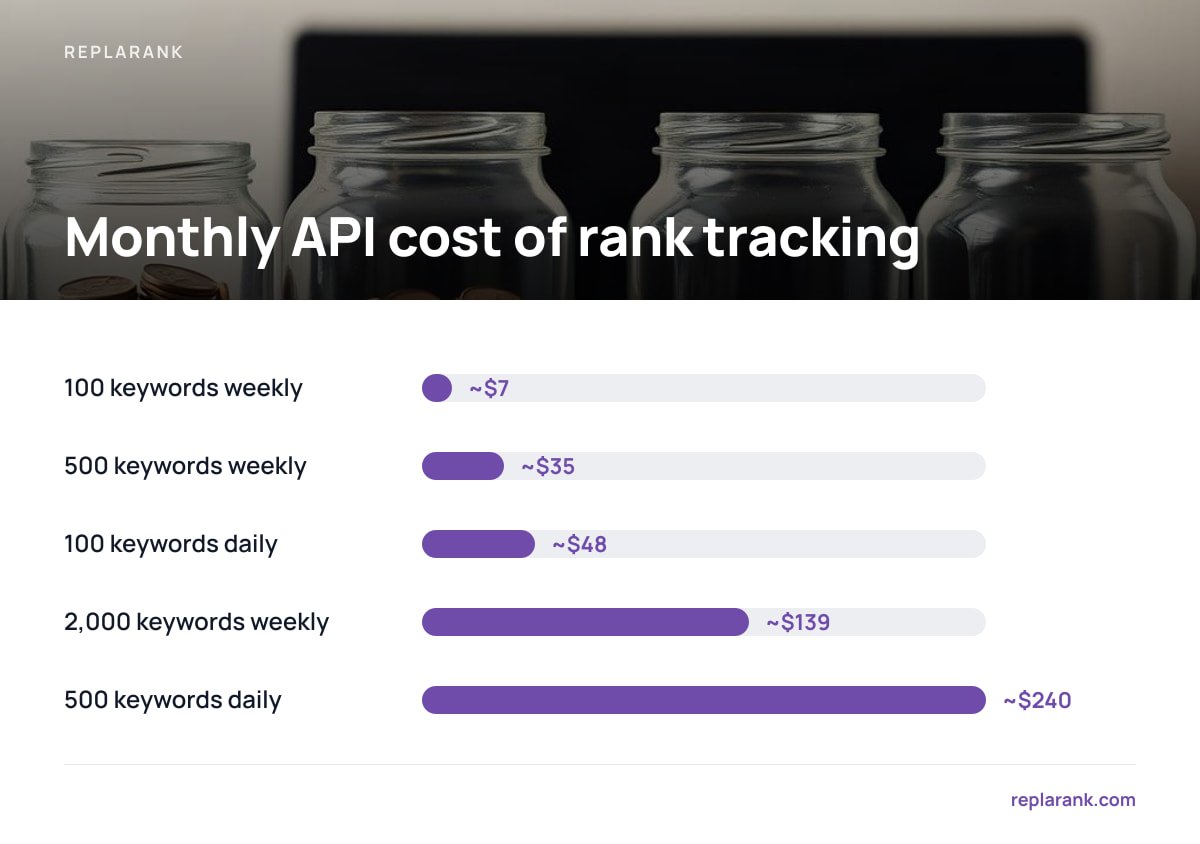
Rank tracking is a clear case where per-call API pricing can beat a subscription or lose to it badly. A fresh rank check from a search-data API costs roughly 1.6 cents. Here is how that plays out:
| Keywords | Check frequency | Checks per month | Approx. API cost per month |
|---|---|---|---|
| 100 | Weekly | ~433 | ~$7 |
| 500 | Weekly | ~2,165 | ~$35 |
| 100 | Daily | ~3,000 | ~$48 |
| 500 | Daily | ~15,000 | ~$240 |
| 2,000 | Weekly | ~8,660 | ~$139 |
500 keywords checked daily at about 1.6 cents each comes to roughly $240 a month, nearly five times a $49 entry-level subscription.
If you need daily positions on a large keyword set, a subscription is cheaper. Paying the API directly makes sense for weekly checks, for small keyword sets, and for setups where subscriptions charge per site or per seat, since those fees disappear when you run your own tool. Most rankings don't move enough day to day to justify daily checks anyway. Weekly data is enough to spot trends for most sites. For the full trade-off, read Rank Tracking Tools: The Cost Trade-Off Nobody Explains.
The same logic applies if you connect an AI assistant to your SEO data. Every tool call the assistant makes may trigger a paid API request underneath. AI SEO Agent: What It Can Do, What It Fakes, What It Costs works through that math.
Pay the Search-Data Provider at Cost and Own Your Rank Tracker for $399

ReplaRank is a self-hosted rank tracker you buy once for $399 and run on your own server. You pay DataForSEO directly for each check at their price, with no markup. Each brand you track gets its own spend limit, so one client's keyword set can't drain another's budget. Your setup includes unlimited sites and users, mobile and desktop tracking across 35 countries, page-health checks for 404s, redirects, noindex and canonical issues, and a daily Search Console sync that keeps click data beyond Google's 16-month limit. A 50-tool MCP server runs locally for Claude Desktop, Claude Code and Cursor.
The caveat follows directly from the table above. If you check 500 or more keywords every day, a subscription will cost you less, and you should buy one. The economics work for weekly schedules and smaller sets. Run the formula on your own numbers first. The DataForSEO setup guide shows what your first calls will actually cost.
Frequently Asked Questions
Do API calls cost money?
Some do and some don't. Many APIs, including Google's Search Console API and most of Meta's Graph API, are free to call and capped with rate limits. Data, AI and messaging APIs typically bill per call, per token or per message.
How much does chat AI cost to use?
The consumer ChatGPT Plus subscription costs $20 a month, and there is a limited free tier. The developer API bills per million tokens, with output tokens priced higher than input, so your cost depends on prompt length, response length and volume.
How much does the Facebook API cost?
Meta's Graph API and Marketing API have no per-call fee. Access is controlled through app review and rate limits. The WhatsApp Business Platform is the billed exception, priced by message category and recipient country.
Why do companies charge for APIs?
Each call costs the provider compute, bandwidth or purchased data. Charging per call also discourages abuse of shared capacity. For data providers, the API is the product itself.
How do I calculate API costs accurately?
Count calls, not keywords or users. Multiply items by device variants, locations and frequency, then add a margin for retries. Use the provider's live pricing page rather than a third-party calculator, because prices change often.
Is per-call rank tracking cheaper than a subscription?
Only at lower volumes or frequencies. At about 1.6 cents a check, 500 keywords tracked weekly costs around $35 a month, while the same keywords tracked daily cost around $240, which is more than an entry-level subscription.
Sources
- API Pricing | OpenAI
- Pricing | Anthropic
- Graph API Rate Limiting | Meta for Developers
- WhatsApp Business Platform Pricing | Meta for Developers
- Search Console API Usage Limits | Google for Developers
- Pricing | DataForSEO